

Last month, I saw the news that Filter was shutting down. For eight years, Filter was a rare refuge for writers and journalists, activists and organizers dedicated to drug policy and harm reduction. The site owned the drug beat like none other. I read it constantly and I cherish the work so many of us contributed.
I will never forget the thrilling 24-hour sprint to break the news that President Joe Biden was selecting Dr. Rahul Gupta to be his director of drug policy. Somehow, Will Godfrey (Filter's founder and editor) and I beat every legacy outlet to the punch. Not just breaking the news, but publishing a full accounting of Gupta's sketchy policy record in West Virginia, where he had shut down a syringe program under political pressure.
Filter held his feet to the fire. It didn’t matter that he was a Democrat in what was supposedly the most progressive administration. We didn’t pull punches based on partisanship. Filter routinely punched above its weight as a small, independent outlet. It changed the way other outlets cover drugs and it’s a massive loss to see it shutter.
It got me thinking: Filter going offline feels like the end of something. The end of something much bigger than one website, the end of something that I don’t quite know how to articulate, let alone mourn. But I’m going to try and do both here.
For well over a year, I’ve had the feeling that, as journalism steadily declines—its credibility in the gutter and its finances sinking deeper into the abyss—that drug journalism is being ground to dust.
When I first jumped on the beat, drug journalism was lively, interesting, and boundary pushing. I was excited to join a group of fearless people challenging conventional wisdom that had hardened into dogma. Piece by piece, writers and journalists took a hammer to assumptions that had fossilized into stale, tired, and cliche coverage. Powerful institutions were investigated. Old ideas were interrogated, like recovery being synonymous with total abstinence. Or that to be truly “sober” one had to go to meetings for the rest of their life and have a vaguely spiritual outlook on life. The notion that people still using drugs were beyond hope and could not be helped unless they hit rock bottom and experienced some tough love.
These old narratives took a beating. And there was an opening for new ideas and ways of thinking. As I got started, around 2014, here is what was being published:
2015: Gabrielle Glaser wrote a viral story into 12-Step dogma for The Atlantic. It was a cover story and it exploded on the scene and sparked days, maybe weeks, of commentary.
2015: Jason Cherkis, in The Huffington Post, investigated the systematic suppression and discrimination of methadone and buprenorphine as options for treatment in an industry dominated by abstinence.
2016: Maia Szalavitz took a major swing in her book Unbroken Brain. It was covered and reviewed everywhere and from there it was off to the races. The drug beat was injected with life.
2016: Even local news outlets invested massive resources into drug coverage. Cincinnati Enquirer published a riveting story called Seven Days of Heroin. Boston Globe was analyzing the language of addiction.
2017: Alec MacGillis in ProPublica investigated the shady ties between law enforcement and Alkermes, the manufacturer of Vivitrol, which resulted in a false and misleading marketing campaign against agonist treatment.
It is jarring to juxtapose how ambitious and curious and incisive this work is with what little gets published today.

Take a recent Atlantic story that parachutes into Seattle to zoologically gaze upon unhoused drug users. The thrust of the story argues that syringe programs and other harm reduction practices are responsible for creating a zombie apocalypse. Studied practices that prevent disease, infection, and death are framed as coddling “addicts” who actually need a heafty dose of tough love and probably long-term incapacitation. We have seen hundreds of these stories, of course, written about Portland, San Francisco, Los Angeles. Curiously, every West Coast city where it costs $2,000 per month to rent a closet to live in has this same odd pattern of destitute people using drugs on the street. Very curious indeed.
Writing these kinds of stories means you don't have to get to know, let alone talk to, someone who uses drugs on the street. Why would you interview a zombie? They are sub-human and non-sentient.
I’m not saying everything published right now is like this. What I am saying is that the room to challenge old ideas and think critically about drug use, criminal justice, public health and homelessness, is shrinking. The opportunity to take big swings is vanishing.
There was a time when a different article about Seattle would have been written. Maybe that piece would take aim at the failures of governance in a city beset by yawning inequality. Legacy coverage of drugs is backsliding toward old school dehumanization.
In the words of the internet today, there has been a vibe shift. And in the current mood there is little appetite for the type of stories that were commissioned left and right not long ago. But it’s also more than just a vibe shift and changing of tastes and mood.
I decided to try to quantify what I’ve been seeing. Namely, this suspicion that attention paid to the subject is on the wane. There used to be several writers and journalists constantly publishing stories on the beat, and now I can only count a few.
So I built a query in Media Cloud, a platform connected to large databases of news articles, to analyze attention over time. The chart below tracks the rise and fall of the drug beat from 2014 through 2026 (ending Aug. 31). The chart tracks a surge of interest around 2015, a high peak in 2017-2018, and then a sharp decline with a few spikes here and there (mostly regarding stories about settlement money and lawsuits).
As attention fades, 70,000 people are still dying of drug overdoses each year, the same number as when the crisis was declared a national emergency in 2017.
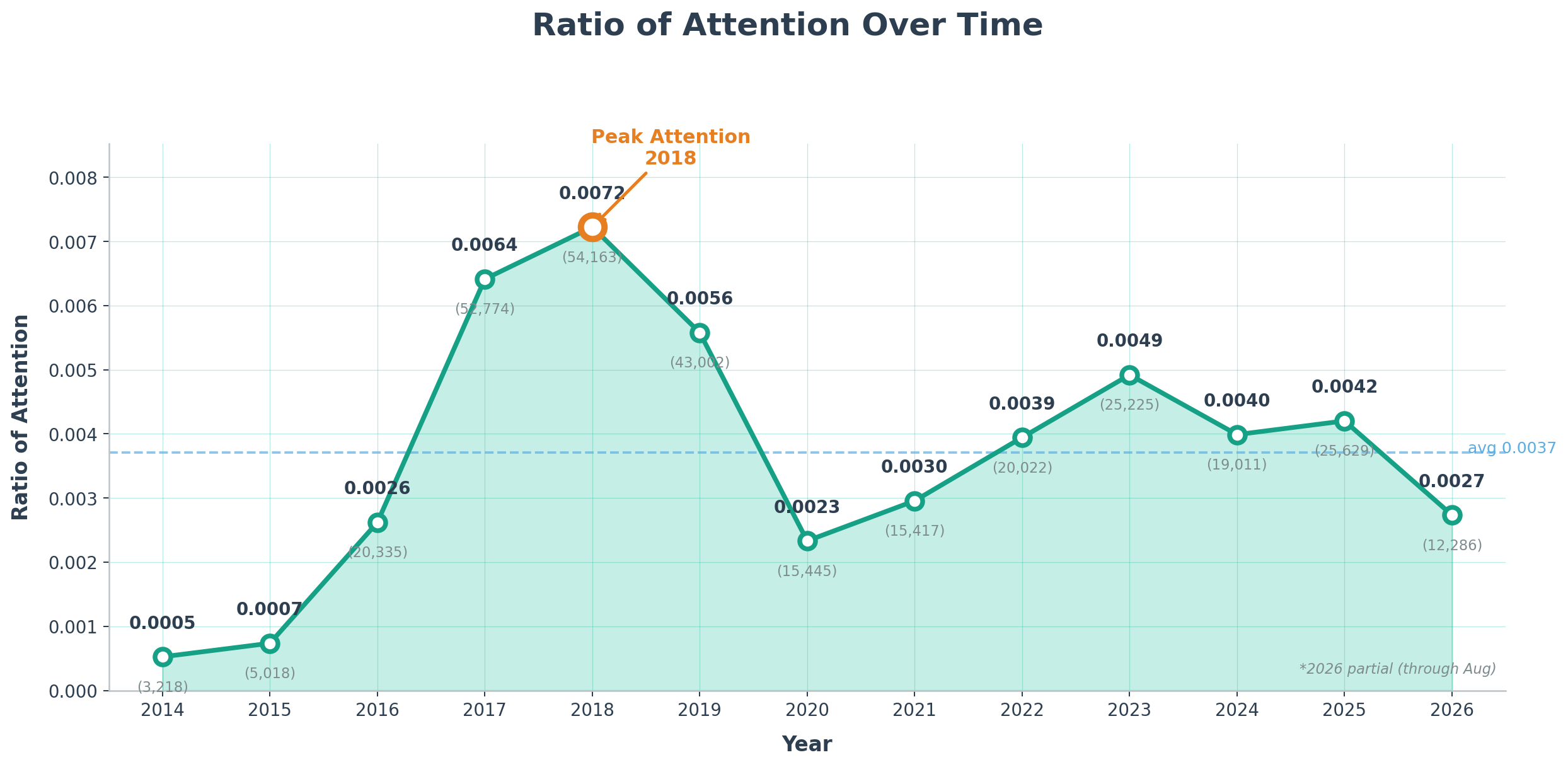
I see the chart showing a few things: After the pandemic, coverage fell off a cliff. Which makes sense. How many public health emergencies can there be? Turns out a lot and they’re all competing for attention. I also see a mass casualty event become ambient background noise. People dying preventable deaths is another grim fact of American life that we are supposed to learn to live with.
I hear phrases like “compassion fatigue” and burnout but I don’t think these pat phrases do enough to explain the decline. Surely it’s in the mix. Especially on an issue like this that gets framed as a neverending crisis. A crisis with no end is a story with no arc or shape. The opioid epidemic, after all this time, is more like an opioid endemic. High drug mortality becoming a constant presence.
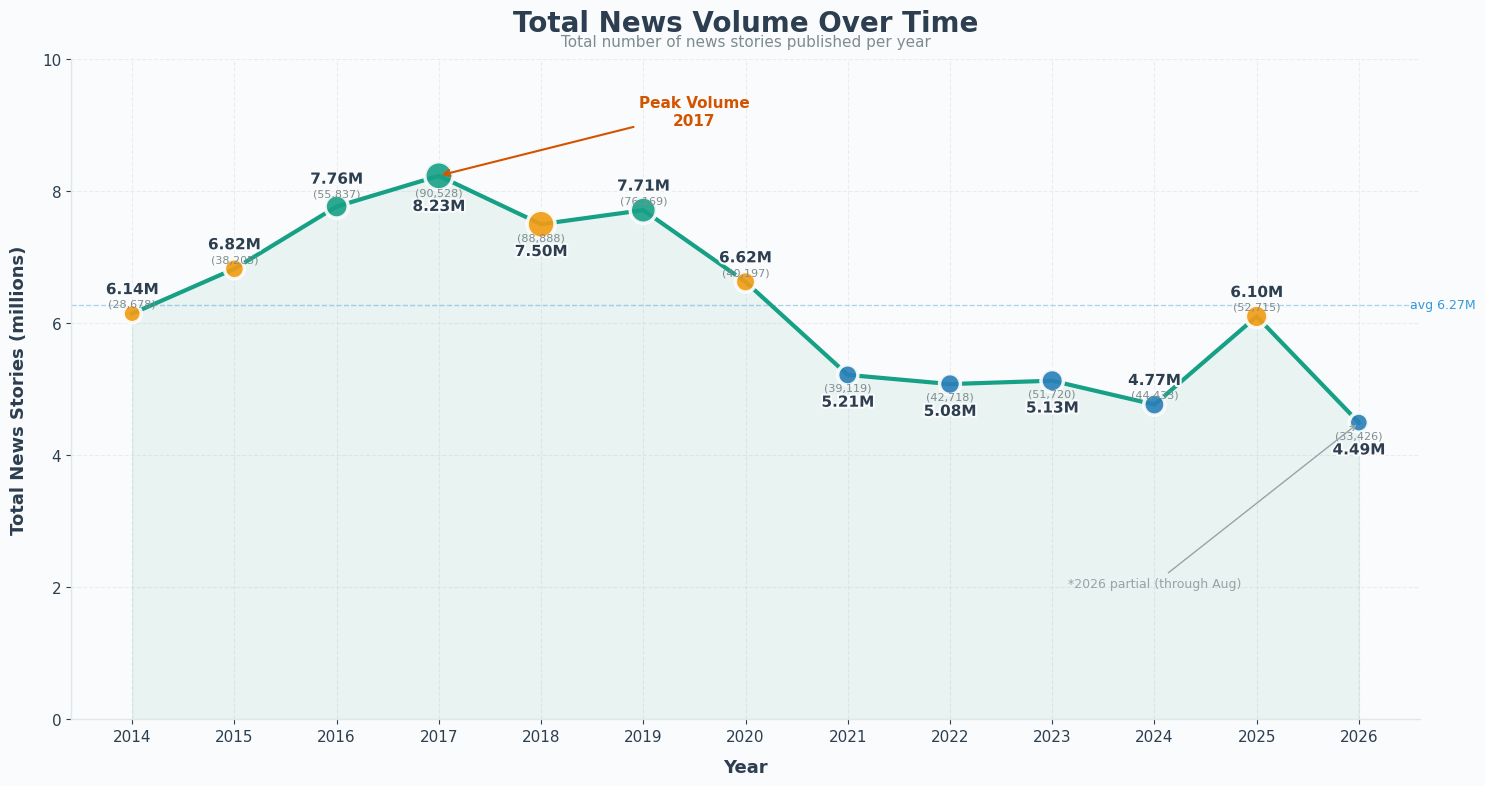
But there is also a structural explanation. Journalism is in ruins. If you don’t work in media it’s hard to appreciate how bad things are.
Since 2005, the U.S. has lost close to 3,500 newspapers, leaving most American cities and towns with little or no local coverage. The days of Google being a driver of traffic is over. AI Overview—and LLMs in general—are throttling traffic. Employment in journalism has fallen by more than three-quarters in this same window. Advertising revenues are tanking, creating a vicious loop of newsroom closures and more job losses. The few surviving outlets increasingly churn out national wire stories rather than original reporting.
In this decay, journalism is losing its capacity to cover anything outside a shrinking set of national flashpoints concentrated in Silicon Valley, Washington, D.C., and New York. The everyday beats that outlets throw resources at increasingly look like this:
Here is what this AI CEO said today.
Here is what Trump said today (I’m sure it was really bad!).
Here is the newest crazy person to enter the political scene in D.C.
Here is the latest way the internet is making everybody insane
This is occasionally interrupted by news from one of several war zones or climate disasters flaring up around the world at any given moment.
The issue here isn’t just one of fatigue, burnout, or disinterest. The market for coverage on this subject — and a lot of others in public health and criminal justice — is dying on the vine.
Will told me it was a massive struggle for Filter to survive in this environment. It became harder and harder to raise enough money to pay staff and keep the lights on. Funders and donors all over are bailing on media.
It wasn’t always like this. In fact not long ago being a drug journalist for me was a full-time job that I could barely keep up with. There were too many stories and things to cover. And that’s the story I want to tell here: How the drug beat exploded, what happened to it, and what it would take to bring it back to life. Drug journalism needs a shot of Narcan. Fast.
And no, a few niche Substacks are no replacement for a robust news operation. I like writing newsletters because I just love to write but this is not the same thing as being part of a real news organization.
Part 1: The Beat Blew Up
First, I pretty much owe my entire writing and journalism career to the likes of Will Godfrey, Maia Szalavitz, Tracey Helton, and Maer Roshan (former EIC of The Fix) — all of whom pioneered drug coverage in the digital era as I was coming up. Tracey and Maia, especially, were always generous with me. They were basically the only writers dedicated to covering drugs and harm reduction as a political and social movement. By that I mean they actually talked to people who used drugs. They actually talked to people who broke laws to help those people. They talked to doctors, researchers, lawyers, organizers, street medics, and so many others who live and work and dedicated their lives to this field.
Back then, we never felt like we were competing against each other as writers and journalists because there were so few of us. There was a spirit of collaboration, passing along tips and sources, and happily sharing the right editor’s email.
The rest of this post is for paid subscribers.
