

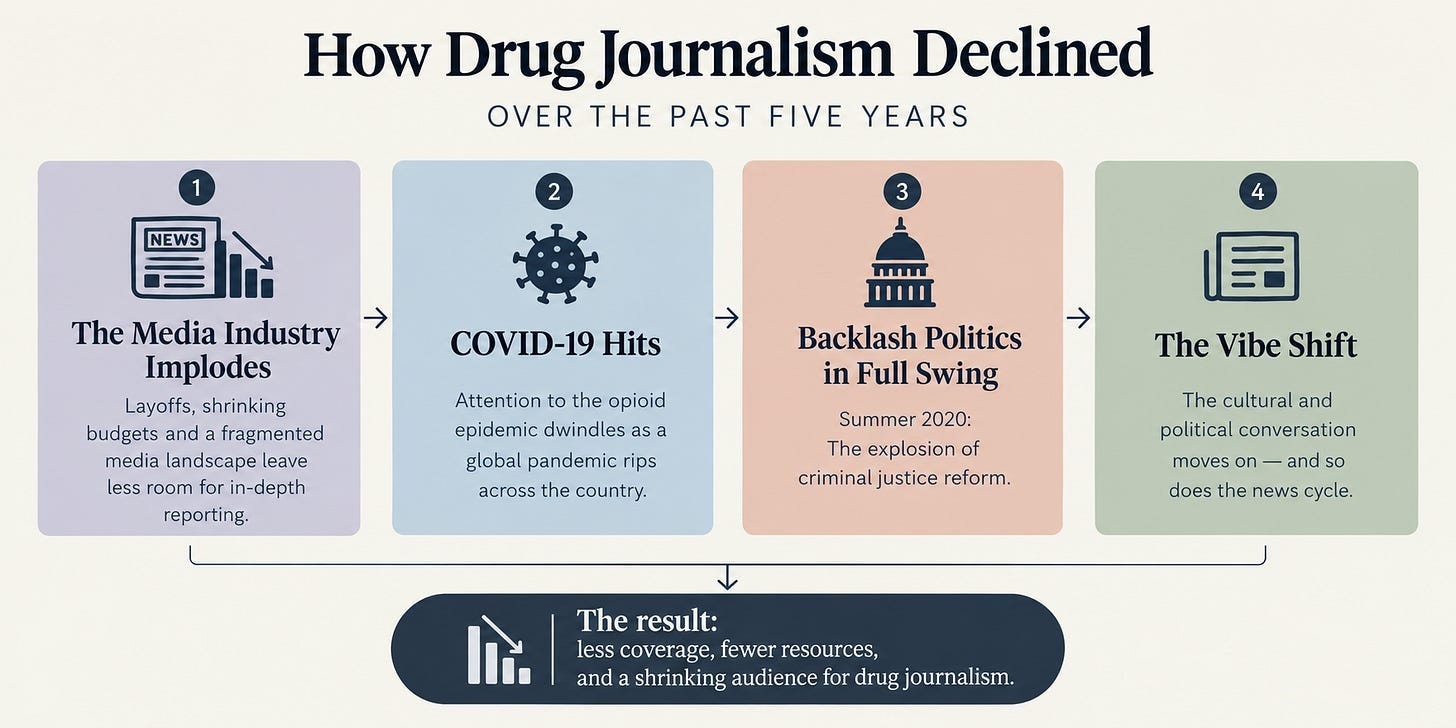
In Part II I am going to analyze the primary causes driving the dwindling coverage and interest in drugs, opioids, the overdose crisis, harm reduction, and addiction.
The chart from Part I depicts the fading coverage as coinciding with COVID, a global event that brought us all online and then melted our minds. In the aftermath of the pandemic the news industry takes a sharp turn. I remember talking to other journalists and freelancers during this time and we started to feel like something was off. Things were tilting.
The news industry was already at its nadir but there was somehow a trapdoor and the industry sunk even lower.

Before taking the plunge I just want to chronicle how strange everything felt around this time. It’s hard to overstate how weird everything became after 2020. The murder of George Floyd, whose death we all watched on video, led to the largest protests in American history, and was followed by zero legislation or material change. And this made everyone feel kind of crazy.
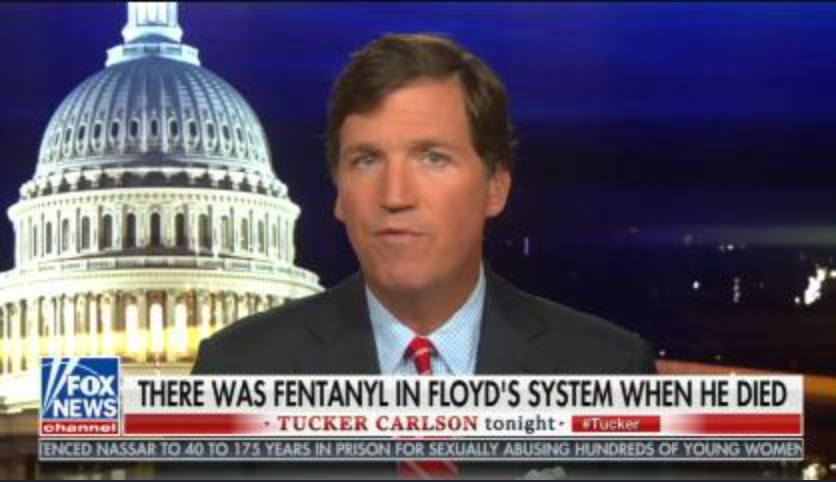
If you recall the narrative around Mr. Floyd’s death, the conspiracies peddled by right-wing anchors like Tucker Carlson, involved an elaborate (and empirically false) story that George Floyd was not killed by a cop who knelt on his neck for 9 and a half minutes. The story they landed on was that he died of a fentanyl overdose. That drove me insane. That story wouldn’t go away matter how many times we “debunked” it. Even smart people I know in real life believed that Mr. Floyd died from fentanyl. Looking back, maybe it was a sign that backlash was coming.
The massive protests over Mr. Floyd’s death fizzled out and nothing really changed. There wasn’t any criminal justice reform to show for it. No police departments were actually defunded. That’s the moment when Anton Jäger’s thesis about “hyperpolitics” feels like it holds true.
Hyperpolitics is a somewhat self-explanatory term: individuals are hyper politicized and feel a deep, intense, affective attachment to their political positions, but there is no real way to enact change. There is no mass collective to join. No mechanism for action. No representative to do your bidding. And this mode of politics, according to Jäger, a political theorist, is also partly why everyone feels insane right now.
The lack of a robust news media feels like it’s also in the mix to me. Most people get their information from social media today, which means highly emotionally activating information is whizzing by you like machine gun fire. A more normal media ecosystem, with less influencers and opinion-mongers and more reporters, editors, and fact-checkers probably would help us sort through these strange times.
After a while on the beat, I felt the overdose crisis succumb to its own version of hyperpolitics. No matter what anyone did, things were not improving. Despite billions in funding and more attention than ever, deaths just kept climbing.
I would talk to people who knew precisely how to prevent overdose deaths en masse; how to treat addiction more humanely and effectively; how to scale naloxone distribution; how to effectively broadcast that the drug supply was changing, becoming more toxic and lethal. People knew what to do but there was no way to make things happen.
Everything got worse and weirder in 2022 after Elon Musk acquired Twitter. Because reporters and editors are on Twitter all the time, they started to inhale the right-wing miasma emanating from the platform. The vibes, once again, shifted.
I find it funny that in our highly quantified world, where “data” is as prized as oil or gold, we hear so much talk, especially in the media, about “vibes” and “the vibe shift.”
No matter how badly we want to tag, index, and transmute the entire world into quanta, metrics, analytics, and data, there is still something too human that can’t be quantified. So we call it “vibes.” If you watch the show Love Island, you will be stunned by how often the islanders use words like “vibe” to discuss all manner of immaterial, hard-to-discern relationship dynamics.
The vibe was off. There was a vibe. We vibed.
The vibes changed during Biden’s term. Drug policy and criminal justice reform fell off the map.
And the final layer in this cake was the arrival of LLMs like ChatGPT in late-2022. As someone who writes words for a living, I can say definitively that LLMs have changed the endeavor of human writing. Especially on the internet and especially for the news. There’s a reason ChatGPT can mimic news-speak so well: OpenAI stole all of our work and fed it to the model. Big tech would once again destroy the hard work and labor of the news industry.
Death by a thousand cuts
I ended Part I saying I was somewhat insulated from the brutal economics of 21st-century journalism. That’s because, in my late twenties and early thirties, I landed a series of fellowships, grants, and major funding opportunities. Those paid me very well on top of the mostly low fees and contracts (and I mean poverty wages, in hourly terms) from the news outlets I worked for.
On top of that, I always had some odd ghostwriting or editing job going. I edited and ghostwrote whole books to fund my own journalism projects. I edited an entire U.S. Surgeon General’s report about community health and economics for $150 per hour. Other times I was handsomely paid to write corporate boilerplate for a tech companies. The days of huge checks coming my way to do these projects are gone.
That’s how I survived as long as I did, by stitching together three or four revenue streams that added up to a good living. Then, the insulation I had became thin. Funding for major projects dried up. Donors in the criminal justice movement tightened the strings. I could start to feel the elements, the chilly macro-winds washed up on my shore.
Turns out there was an even rockier bottom below what I thought was rock bottom.
The macro dynamics of the dying news industry go something like this:
Craigslist killed classifieds (formerly a huge revenue stream for papers)
Big Tech (ahem, Google & Facebook) vacuumed up ad revenue
People got used to reading free stuff on their phones
The endless pivot to video. Then vertical video. Then podcasts. Then video podcasts.
The way to survive all this became another nail in the coffin for my specific temperament, which was to become a journalist-influencer-one-man-show. Someone who shared a lot about their everyday life, posted a lot of videos and pictures of themselves looking hot, constantly mixing the personal with the professional, and crucially, never disclosing whether the current post or topic was underwritten by a company or brand. And you must constantly post videos of yourself talking about your reporting.
All of this was happening while private equity gobbled up newsrooms, laying off staff, turning a good product into a crappy one, and selling off desk chairs and office space in the chase for short-term profits
These macro trends coincided with a decade-long decline in public trust in the media. Only 32 percent of Americans express trust in the mass media, according to recent data from Gallup News. We’re viewed as out of touch and constantly getting the story wrong. Then there is partisan sorting and polarization.
All of these trends are why the data from Northwestern’s journalism school, which tracks the slow death of local news, looks so grim. As of 2023:
More than 33% of newspapers have folded in the last 20 years.
There are 5,600 newspapers left in the U.S.
206 counties have no local news source.
1,561 counties have only one local news source.
7,000 newspaper jobs were lost in 2023 alone.
Below is a chart from a climate newsletter called Report Earth, and it shows that every single year since the financial crash of 2008, the news business has gotten worse and never recovered.
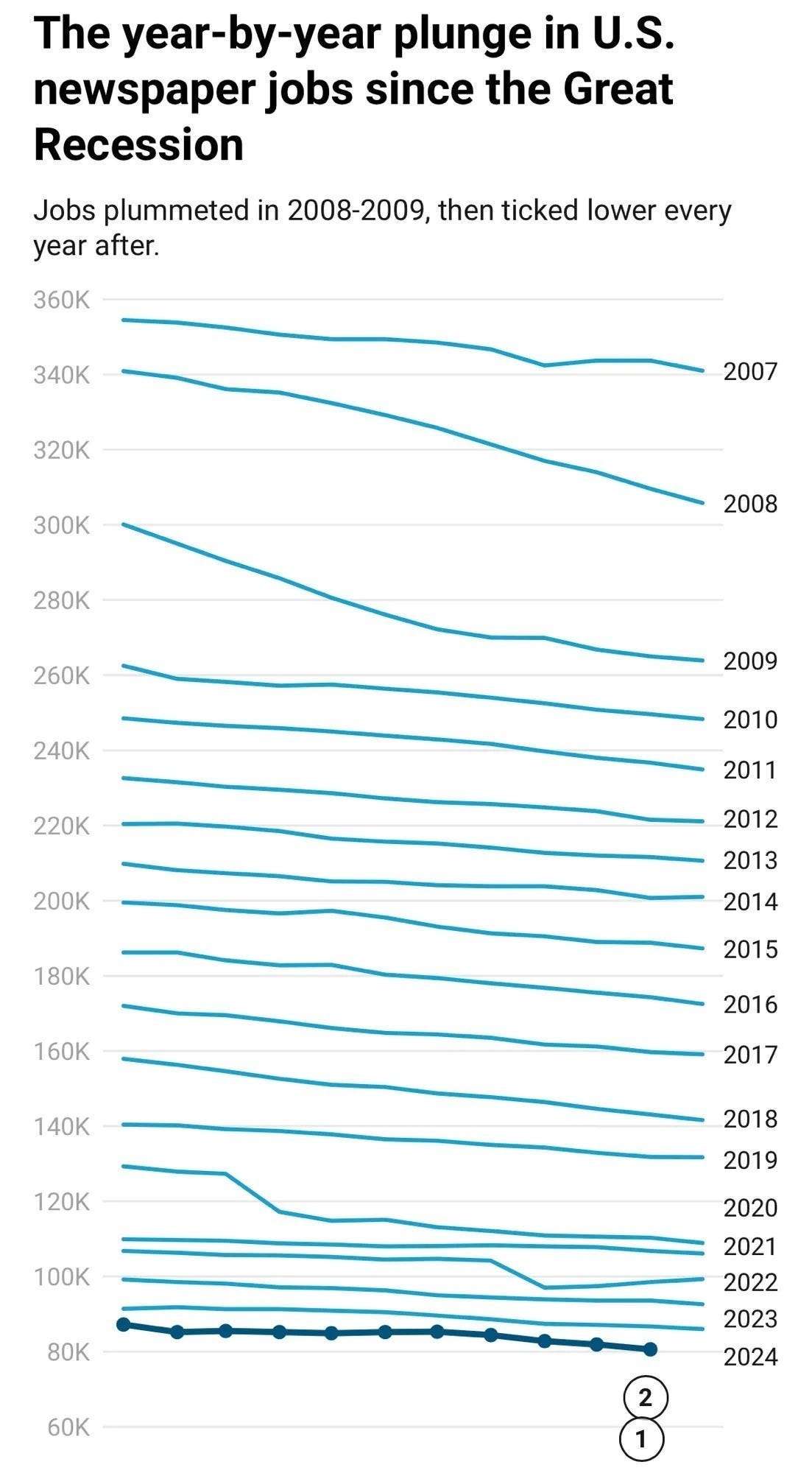
Over the last 20 years, the number of jobs in local journalism has dropped by 80 percent, leaving roughly 25,000 local journalism positions across the entire country. For contrast, there are an estimated 1.5 million to 2 million professional software developers in America. There are more than 250,000 graphic designer jobs and more than 130,000 web and digital interface designer jobs.
I also came across an insane stat. The New York Times, America’s only thriving newspaper, fully employs maybe than 10% of every working journalist with a salary right now. NYT is about to be a journalistic monopoly in a country of nearly 400 million people (most of whom do not live in New York) and that is going to be very bad for everyone.


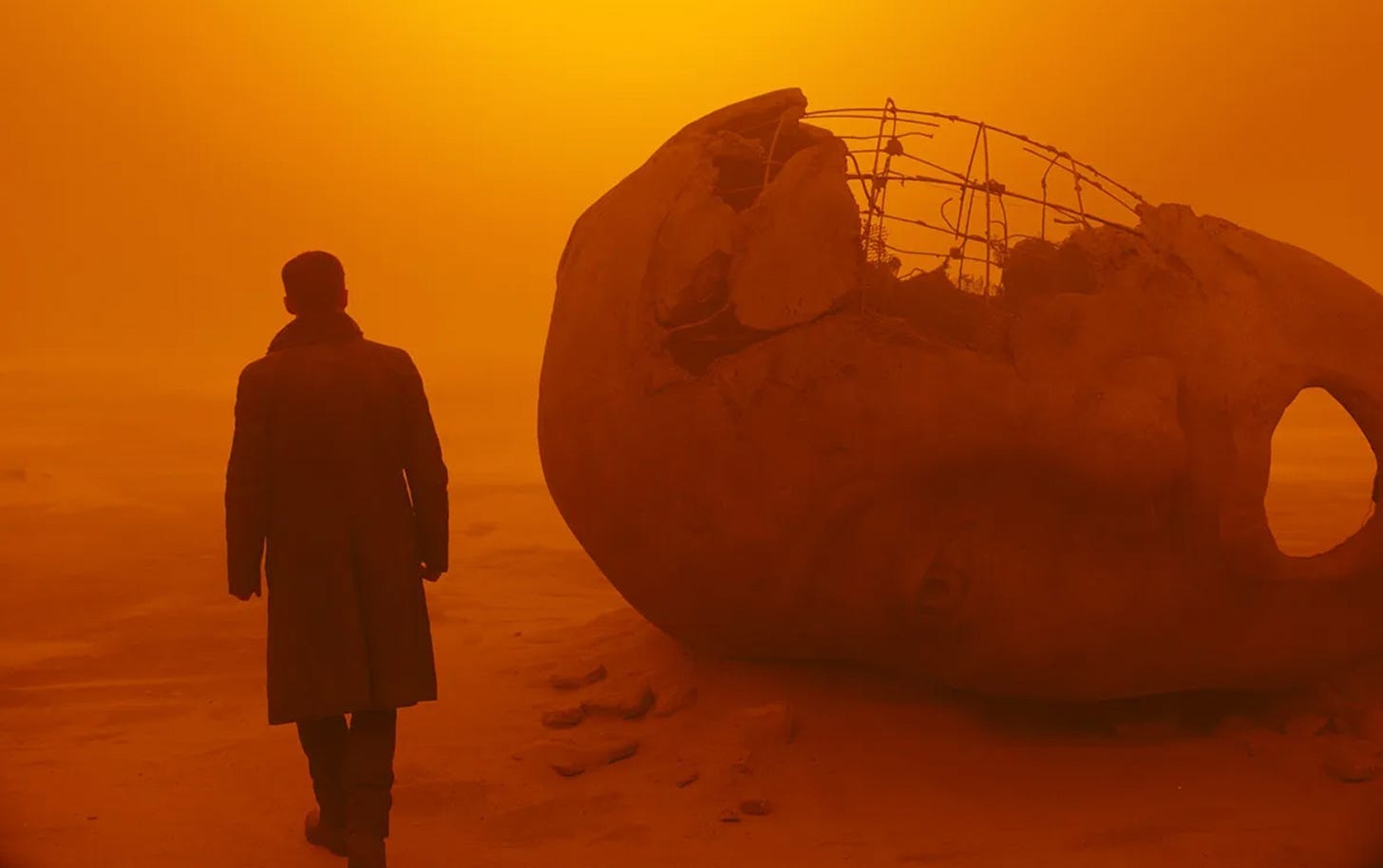
Northwestern uses the term “news deserts” to map the vast swaths of America that have no newspapers telling people what’s going on where they live. But even some life flourishes in a desert. What I see looks more desolate and, at least if you need money to live, uninhabitable. The news business as I see it today is more like the dusty, lifeless red Las Vegas of Blade Runner 2049.
The drug beat in decline
On to the drug beat. Part I, I charted how the drug beat blew up. In a good way. Part II is trying to figure out the cultural, political, and “vibe shift” that led to coverage and interest in the subject fading from prominence.
In the early 2010s, during peak millennial digital media, there were drug stories everywhere, everyday. And I was basically at the right place at the right time to jump on the beat.
I had deep knowledge of opioids, drug markets, addiction science, and, not to mention, a personal history that gave me credibility with sources who otherwise would not open up and share their story. I was also uniquely recovery agnostic. I did not claim to be saved by any single method. I held no allegiance to 12-Steps or other non-12-Step groups. Apart from a few personal stories I published over the years I barely mentioned the fact that I had my own addiction history. The story was so much bigger than me.
But my ability to talk and get people talking was always my edge. And we would talk and talk until people started speaking in their own voice rather than the sort of surface-level, boilerplate, boring talk that we all use most of the day to prevent going too deep below the surface. In this era of the drug beat I felt tremendous inertia and momentum flinging me forward.
The rest of this piece is for subscibers only. Thanks to all those who support my work. I couldn’t write these long posts without your help.
